
Whitepaper

Senolytic drug combo boosts cancer immunotherapy and reduces side effects

Drug Target Review Drug Target Review
1 Oct 2025 2 min read

Login or Register

After logging in, you can access the full content
Researchers have discovered that targeting immune cell ageing can overcome resistance to head and neck cancer treatment.

Head and neck squamous cell carcinoma (HNSCC) is a malignant tumour originating from epithelial cells. Chemoimmunotherapy has improved pathological response rates in patients with locally advanced HNSCC. However, its effectiveness is limited by variable patient responses, overlapping treatment-related toxicities and drug resistance.     

Immunosenescence linked to treatment resistance

The study, published in Nature Medicine, was led by Associate Professor XU Fang from the Shenzhen Institutes of Advanced Technology of the Chinese Academy of Sciences, in collaboration with researchers from Sun Yat-sen Memorial Hospital, Sun Yat-sen University, Guangzhou National Laboratory and Harvard Medical School.

The research collaboration demonstrated that immunosenescence plays a key role in treatment resistance, showing that targeting senescent immune cells improves the effectiveness of immunotherapy.

Phase II trial identifies immune ageing in non-responders

The researchers first conducted the oral/oropharyngeal squamous cell carcinoma (OOC-001) phase II trial, in which 51 patients with resectable HNSCC received neoadjuvant chemoimmunotherapy. In 23 of these patients,  the cancer disappeared completely.

Single-cell multi-omics profiling demonstrated that non-responding tumours displayed prominent features of immunosenescence – including reduced CCR7+ CD4+ naïve T cells and CD27+ memory B cells.

Senolytic drugs restore immune function in animal models

The researchers also tested senolytic drugs in animal models. They found that the combination of dasatinib and quercetin with PD-1 blockade significantly reduced tumour burden and extended survival. This surpassed the efficacy of PD-1 inhibitors alone or in combination with chemotherapy.

Importantly, the senolytic combination restored naïve T cell function and reversed markers of immune ageing.

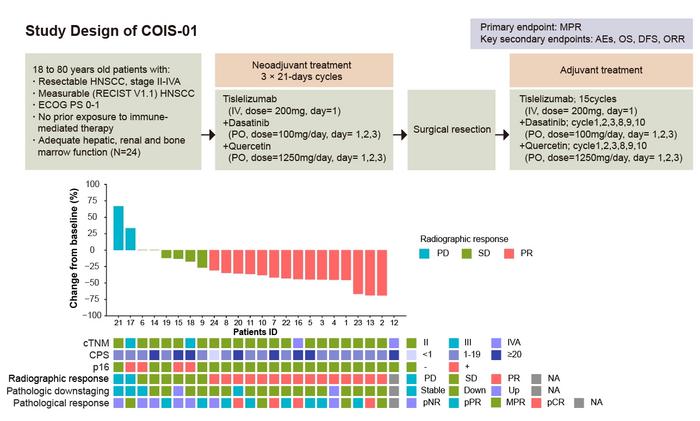
[caption id="attachment_188811" align="aligncenter" width="700"] Study design and patient characteristics from the COIS-01 Trial. Credit: SIAT[/caption]
Clinical trial demonstrates lower toxicity and promising responses

Building on these results, the researchers launched a phase II clinical trial (COIS-01) testing senolytics plus immunotherapy. A total of 24 patients with resectable HNSCC received neoadjuvant treatment with anti-PD-1, dasatinib and quercetin.

The regimen achieved a 33.3 percent major pathological response rate with markedly lower toxicity compared to chemoimmunotherapy. Only one patient experienced grade 3-4 adverse effects, compared with more than half in the chemoimmunotherapy cohort.

A new direction for solid tumour immunotherapy

By combining senolytic drugs with immunotherapy, researchers not only improved tumour response but also reduced treatment-related toxicity. This new approach to treating head and neck squamous cell carcinoma could change outcomes for patients – offering more effective and safer cancer treatments in the future.

Related Whitepapers

Animal Models
Cancer research
Drug Discovery
Drug Targets
In Vivo
Oncology
Therapeutics
Translational Science
+7
06 November 2025

Protein FSP1 found to help melanoma survive in lymph nodes

New research has discovered a key survival mechanism in metastatic melanoma, revealing that cancer cells spreading to lymph nodes depend on a protein ...

Drug Target Review Drug Target Review
Nov 6, 2025 • 1 min read
Animal Models
Drug Development
Drug Discovery Processes
Immuno-oncology
Immunotherapy
Monoclonal Antibody
Oncology
Translational Science
+7
06 November 2025

Sugar-coated tumours: a new target for pancreatic cancer

Researchers have discovered that pancreatic tumours evade the immune system by disguising themselves with a sugar coating. To combat this, they have d...

Drug Target Review Drug Target Review
Nov 6, 2025 • 1 min read
Analysis
Computational techniques
Drug Discovery
Drug Discovery Processes
Molecular Biology
Structural Biology
Translational Science
+6
06 November 2025

RNA folding: new model could change future drug design

A Japanese research team has simulated how RNA molecules fold, using cutting-edge computational tools to model complex structures with accuracy – a br...

Drug Target Review Drug Target Review
Nov 6, 2025 • 1 min read
Animal Models
Translational Science
+1
31 October 2025

Alzheimer’s brain structure investigated through fruit flies

Scientists have used fruit flies to study 100 genes linked to Alzheimer’s disease and how these genes affect brain structure, function and stress resi...

Carrie Haslam Carrie Haslam
Oct 31, 2025 • 1 min read
Animal Models
Cancer research
Disease Research
Drug Discovery
Drug Repurposing
Oncology
Translational Science
+6
31 October 2025

Migraine drug may help stop bone cancer spread

Scientists have discovered that two existing pain medications – bupivacaine and rimegepant – may not only relieve the severe pain caused by osteosarco...

Carrie Haslam Carrie Haslam
Oct 31, 2025 • 1 min read
Central Nervous System (CNS)
CRISPR
Epigenetics
Molecular Biology
Neurons
Neurosciences
Therapeutics
Translational Science
+7
30 October 2025

CRISPR epigenetic ‘switch’ provides new way to control memory

For the first time, researchers have demonstrated that flipping an epigenetic ‘switch’ in memory cells can directly control whether a memory is expres...

Carrie Haslam Carrie Haslam
Oct 30, 2025 • 1 min read
Cell Cultures
Cell-based assays
Drug Discovery
Drug Targets
In Vivo
Molecular Biology
Pathology & Molecular Medicine
Therapeutics
Translational Science
+8
30 October 2025

Targeting fibroblasts could lead to new heart failure therapies

Long considered structural support cells, a new research study has discovered how fibroblasts actively worsen heart failure by disrupting heart muscle...

Carrie Haslam Carrie Haslam
Oct 30, 2025 • 1 min read
Animal Models
Central Nervous System (CNS)
Disease Research
Drug Discovery
Drug Discovery Processes
In Vivo
Molecular Targets
Neuroprotection
Neuroprotective compounds
Neurosciences
Translational Science
+10
29 October 2025

Overactive neurons linked to schizophrenia-like behaviour

Scientists have identified an overactive brain cell type linked to schizophrenia-like symptoms in mice – a discovery that could lead to new, targeted ...

Carrie Haslam Carrie Haslam
Oct 29, 2025 • 1 min read