
Whitepaper

Meta-Flux expands AI platform to speed up drug development

Carrie Haslam Carrie Haslam
15 Oct 2025 3 min read

Login or Register

After logging in, you can access the full content

Author

Read Bio
Carrie Haslam
Author

Dublin-based biotech Meta-Flux has raised €1.8M ($2M) in seed funding to expand its AI-driven platform for preclinical drug development, helping researchers predict drug success and accelerate the pathway from lab to clinic.

Dublin-based biotech startup Meta-Flux has raised €1.8 million ($2 million) in seed funding to expand its decision-support platform for preclinical drug development. The company aims to bridge the gap between preclinical research and clinical application, using AI to help researchers identify the most promising therapeutic opportunities.

The funding round includes support from senior executives at Pfizer, Merck and Gilead Sciences, as well as technology leaders from Google, Amazon and Indeed.

Using AI to understand how biology really works

Meta-Flux integrates data from genes, proteins and metabolic pathways, combining biological reasoning with artificial intelligence to show how systems function as a whole. This systems-level perspective enables drug developers to discover better treatments faster and avoid costly dead ends.

Meta-Flux integrates data from genes, proteins and metabolic pathways, combining biological reasoning with artificial intelligence

“Bringing a new drug to market is slow, expensive, and uncertain. Too often, promising drugs fail because researchers can’t clearly predict how they’ll behave,” said Meta-Flux co-founder Lee Sherlock. “A lot of drugs end up failing because they have the wrong application. Our goal isn’t just to get more drugs to market, but to make sure the ones that do actually help the right people. Once you have that drug and once you have the target, we help you figure out what application you should go after, what particular type of disease, what subtype of that disease, and what patients you’re going to be treating.”
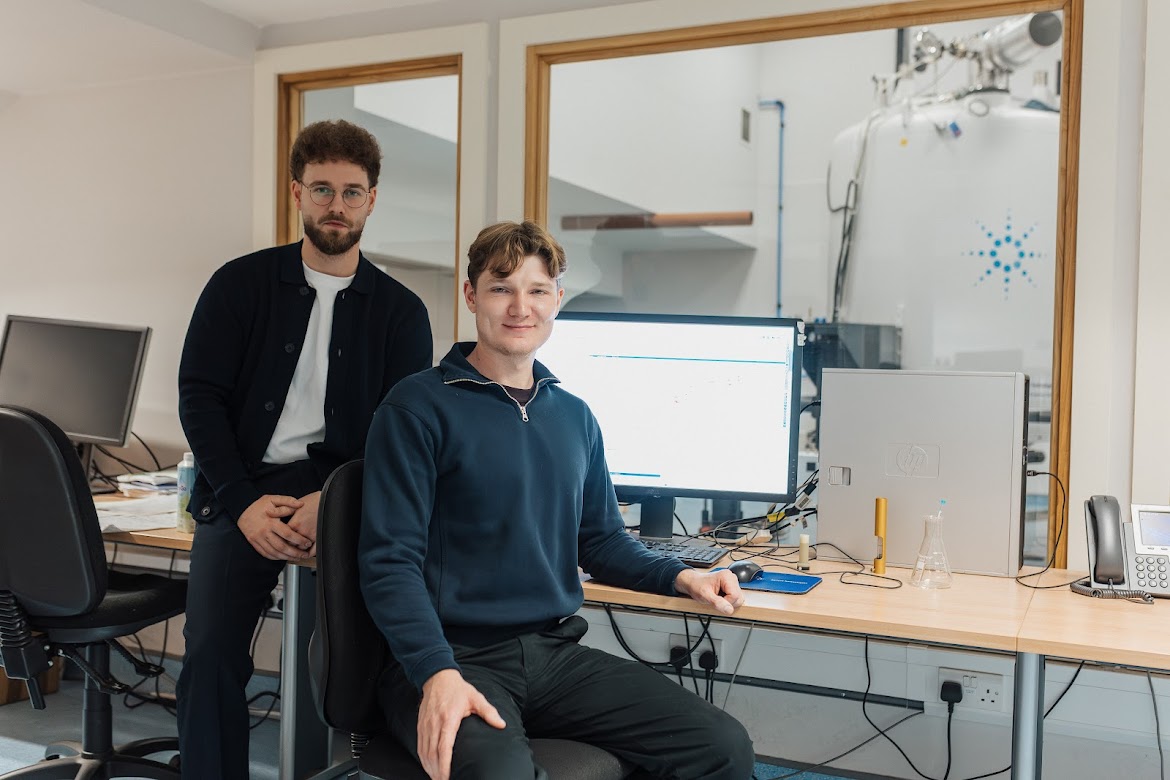
Meta-Flux co-founders Lee Sherlock (CEO) and Brendan Martin (CTO) at Trinity Biomedical Sciences Institute (TBSI) in
Dublin, with an 800 MHz NMR spectrometer.

Standing out in an AI-saturated market

As AI continues to reshape pharmaceutical R&D, Meta-Flux’s approach has demonstrated careful attention for turning complex data into actionable insights.

“In a market saturated with AI claims, Meta-Flux stands out because it delivers actionable answers,” said Fernando Ferrer, a data engineering leader and investor in Meta-Flux. “Their platform gives scientists a way to cut through the noise and accelerate the path from development to decision.”

Expanding across Europe and the US

Meta-Flux recently completed three major accelerator programs – Techstars Chicago (powered by J.P. Morgan), MassBio DRIVE in Boston and the NDRC Accelerator at Dogpatch Labs in Dublin – all designed to connect emerging techbio startups with pharma mentors and investors.

Following this seed round, the company plans to expand its team and support new pharmaceutical collaborations across Europe and the United States.

Related Whitepapers

Animal Models
Cancer research
Drug Discovery
Drug Targets
In Vivo
Oncology
Therapeutics
Translational Science
+7
06 November 2025

Protein FSP1 found to help melanoma survive in lymph nodes

New research has discovered a key survival mechanism in metastatic melanoma, revealing that cancer cells spreading to lymph nodes depend on a protein ...

Drug Target Review Drug Target Review
Nov 6, 2025 • 1 min read
Animal Models
Drug Development
Drug Discovery Processes
Immuno-oncology
Immunotherapy
Monoclonal Antibody
Oncology
Translational Science
+7
06 November 2025

Sugar-coated tumours: a new target for pancreatic cancer

Researchers have discovered that pancreatic tumours evade the immune system by disguising themselves with a sugar coating. To combat this, they have d...

Drug Target Review Drug Target Review
Nov 6, 2025 • 1 min read
Analysis
Computational techniques
Drug Discovery
Drug Discovery Processes
Molecular Biology
Structural Biology
Translational Science
+6
06 November 2025

RNA folding: new model could change future drug design

A Japanese research team has simulated how RNA molecules fold, using cutting-edge computational tools to model complex structures with accuracy – a br...

Drug Target Review Drug Target Review
Nov 6, 2025 • 1 min read
Central Nervous System (CNS)
Drug Targets
Enzymes
Mitochondria
Neuroprotection
Neurosciences
Pharmacology
Translational Science
+7
06 November 2025

BVRA enzyme may slow down Alzheimer’s progression

New research from Johns Hopkins Medicine reveals that the enzyme BVRA protects brain cells from oxidative stress, allowing for potential new methods f...

Drug Target Review Drug Target Review
Nov 6, 2025 • 1 min read
Cell Cultures
Disease Research
Hepatocytes
In Vitro
Induced Pluripotent Stem Cells (iPSCs)
Organoids
Regenerative Medicine
Translational Science
+7
04 November 2025

Lab-grown liver offers new platform to test fibrosis drugs

Japanese scientists have developed a lab-grown liver organoid that mimics human liver regeneration, offering a new platform to study fibrosis and test...

Drug Target Review Drug Target Review
Nov 4, 2025 • 1 min read
Assays
Bioengineering
Biomarkers
CRISPR
Disease Research
Neurosciences
RNAs
Translational Science
+7
04 November 2025

New blood test detects Alzheimer’s years before symptoms

Scientists have developed two rapid and affordable blood tests that can detect early markers of Alzheimer’s disease – potentially decades before sympt...

Drug Target Review Drug Target Review
Nov 4, 2025 • 1 min read
Animal Models
Translational Science
+1
31 October 2025

Alzheimer’s brain structure investigated through fruit flies

Scientists have used fruit flies to study 100 genes linked to Alzheimer’s disease and how these genes affect brain structure, function and stress resi...

Carrie Haslam Carrie Haslam
Oct 31, 2025 • 1 min read