
Scientists have discovered a powerful new antibiotic hidden within the compound pre-methylenomycin C lactone, which shows real effectiveness against drug-resistant infections such as MRSA and VRE.
Chemists from the University of Warwick and Monash University have discovered a promising new antibiotic that could help in the global fight against antimicrobial resistance (AMR). The compound, known as pre-methylenomycin C lactone, has shown strong activity against drug-resistant pathogens, including MRSA and VRE.
AMR is one of the world’s most pressing and urgent health challenges worldwide. A new report from the World Health Organization (WHO) warns there are ‘too few antibacterials in the pipeline’ as most easy-to-discover antibiotics have already been identified.
A discovery decades in the making
The new study was carried out which found the antibiotic was ‘hiding in plain sight’ – as an intermediate chemical in the natural production of the well-known antibiotic methylenomycin A.
“Methylenomycin A was originally discovered 50 years ago and while it has been synthesised several times, no-one appears to have tested the synthetic intermediates for antimicrobial activity,” said co-lead author Professor Greg Challis, from the Department of Chemistry at the University of Warwick and the Biomedicine Discovery Institute at Monash University. “By deleting biosynthetic genes, we discovered two previously unknown biosynthetic intermediates, both of which are much more potent antibiotics than methylenomycin A itself.”
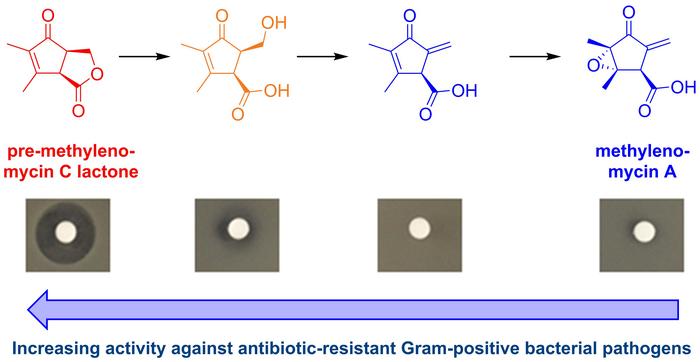
The biosynthesis pathway of methylenomcyin A as discovered in this experiment. The new precursors, especialliy pre-methylenomycin C lactone, show increased potency against Gram-positive bacterial pathogen compared to the original methylenomycin A. Credit: Greg Challis/University of Warwick
Over 100 times more effective
When tested for antimicrobial activity, pre-methylenomycin C lactone proved to be over 100 times more active against a range of Gram-positive bacteria than methylenomycin A. It was particularly effective against Staphylococcus aureus and Enterococcus faecium – the bacteria responsible for MRSA and VRE, respectively.
When tested for antimicrobial activity, pre-methylenomycin C lactone proved to be over 100 times more active against a range of Gram-positive bacteria than methylenomycin A.
“Remarkably, the bacterium that makes methylenomycin A and pre-methylenomycin C lactone – Streptomyces coelicolor – is a model antibiotic-producing species that’s been studied extensively since the 1950s,” said co-lead author Dr Lona Alkhalaf, assistant professor at the University of Warwick. “It looks like S. coelicolor originally evolved to produce a powerful antibiotic (pre-methylenomycin C lactone), but over time has changed it into methylenomycin A – a much weaker antibiotic that may play a different role in the bacterium’s biology.”
Promising resilience against resistance
Most importantly, the researchers did not detect any emergence of resistance to pre-methylenomycin C lactone in Enterococcus bacteria under conditions where vancomycin resistance is usually found. Vancomycin is a ‘last line’ treatment for Enterococcus infections, making this finding especially significant for tackling VRE.
“This discovery suggests a new paradigm for antibiotic discovery. By identifying and testing intermediates in the pathways to diverse natural compounds, we may find potent new antibiotics with more resilience to resistance that will aid us in the fight against AMR,” said Professor Challis
Next steps: pre-clinical testing
The next phase of research will involve pre-clinical testing. A previous report from a Monash-led team working with Warwick researchers reported a scalable synthesis of pre-methylenomycin C lactone. This will be an important step towards further development.
This synthetic route should enable the creation of diverse analogues that can be used to probe the structure−activity relationship and mechanism of action for pre-methylenomycin C lactone.
“This synthetic route should enable the creation of diverse analogues that can be used to probe the structure−activity relationship and mechanism of action for pre-methylenomycin C lactone. The Centre to Impact AMR at Monash gives us a great platform to take this promising antimicrobial forward,” said Professor David Lupton, from the School of Chemistry at Monash University, who led the synthesis work.
With its simple structure, potent activity, resilience to resistance and scalable production, pre-methylenomycin C lactone could represent a major advance in antibiotic development. Researchers hope it may one day help save some of the 1.1 million people who die each year due to antimicrobial resistance.