Whitepaper

Brain’s circHomer1 RNA offers insights for future neurological treatments

Carrie Haslam Carrie Haslam
24 Oct 2025 0 min read

Login or Register

After logging in, you can access the full content

Author

Read Bio
Carrie Haslam
Author

A circular RNA called circHomer1 has been found to play a vital role in forming and adjusting synapses in developing mouse brains, revealing an overlooked mechanism that helps visual neurons respond to changes in sensory input.

Neuroscientists at MIT have discovered that a circular RNA, circHomer1, helps develop synapses in the brains of mice. The findings demonstrate that circHomer1 is crucial for normal synapse formation and for the brain’s ability to adjust when visual input is temporarily blocked.

Building synapses with circHomer1

“It is used to build synapses, for sure,” said co-senior author Mriganka Sur, Newton Professor at MIT. “When you knock it down, the synapses, at least structurally, are not fully built. Then, after monocular deprivation, when the dendritic spines housing synapses normally should shrink, as should responses from the blocked eye, knocking down circHomer1 prevented that for three days.”

In the study, mice with disrupted circHomer1 showed impaired dendritic spine development and delayed adaptation when one eye was temporarily closed, a procedure called monocular deprivation (MD).

Linear vs circular RNA

The Homer gene produces both linear RNA (Homer1a) and circular RNA (circHomer1). While Homer1a weakens excitatory synapses in response to neuronal activity, the new study shows that circHomer1 plays a distinct and crucial role in shaping synapses during development.

The Homer gene produces both linear RNA (Homer1a) and circular RNA (circHomer1).

The team screened for RNAs affected by MD and found 73 circular RNAs with significant changes. CircHomer1 stood out because its expression rose during the first three days of MD, even as Homer1a levels fell, before declining by day seven. During normal development, circHomer1 also increases at the start of the brain’s ‘critical period,’ when circuits undergo intense remodelling.
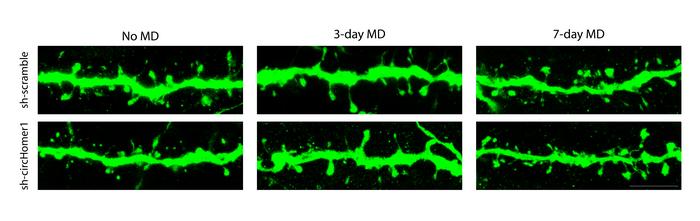
A panel from the paper shows sample neural dendrites under six different conditions: with normal circleHomer1 function (top row) or function knocked out (bottom row), and with no monocular deprivation (left), after 3 days (middle) or 7 days (right). With circleHomer1 disrupted, spines were lessened with no MD. After 3 days of MD circleHomer1 disruption prevented spines from shrinking. After 7 days of MD it made no difference. Credit: Sur Lab/MIT Picower Institute

Effects of knocking out circHomer1

By disabling circHomer1, the researchers observed four conditions: with or without the RNA and with or without MD.

  • In non-MD mice – circHomer1 disruption prevented dendritic spine maturation.
  • In MD mice with normal circHomer1 – neurons serving the deprived eye showed the expected drop in responsiveness and shrinkage of dendritic spines.
  • In MD mice lacking circHomer1 – these changes were delayed for the first three days with reduced removal of AMPA receptor proteins, which normally aids spine shrinkage.

By day seven, however, all effects of circHomer1 loss had vanished, suggesting that other mechanisms may compensate for its absence.

Implications beyond the visual cortex

The study raises questions about how circHomer1 interacts with Homer1a and what mechanisms carry out synaptic adjustments when circHomer1 is missing. While the research focused on the visual cortex, co-author Nikolaos Mellios has been examining circHomer1 in other brain regions, including the prefrontal cortex.

The discovery of circHomer1’s role in synapse development also opens exciting possibilities for future treatments of neurological disorders. By finding a previously overlooked molecular mechanism that shapes how neurons form and adjust connections, the research could guide the development of future therapies aimed at enhancing brain plasticity.


Related Whitepapers

Analysis
Computational techniques
Drug Discovery
Drug Discovery Processes
Molecular Biology
Structural Biology
Translational Science
+6
06 November 2025

RNA folding: new model could change future drug design

A Japanese research team has simulated how RNA molecules fold, using cutting-edge computational tools to model complex structures with accuracy – a br...

Drug Target Review Drug Target Review
Nov 6, 2025 • 1 min read
Central Nervous System (CNS)
Drug Targets
Enzymes
Mitochondria
Neuroprotection
Neurosciences
Pharmacology
Translational Science
+7
06 November 2025

BVRA enzyme may slow down Alzheimer’s progression

New research from Johns Hopkins Medicine reveals that the enzyme BVRA protects brain cells from oxidative stress, allowing for potential new methods f...

Drug Target Review Drug Target Review
Nov 6, 2025 • 1 min read
Assays
Bioengineering
Biomarkers
CRISPR
Disease Research
Neurosciences
RNAs
Translational Science
+7
04 November 2025

New blood test detects Alzheimer’s years before symptoms

Scientists have developed two rapid and affordable blood tests that can detect early markers of Alzheimer’s disease – potentially decades before sympt...

Drug Target Review Drug Target Review
Nov 4, 2025 • 1 min read
Central Nervous System (CNS)
CRISPR
Epigenetics
Molecular Biology
Neurons
Neurosciences
Therapeutics
Translational Science
+7
30 October 2025

CRISPR epigenetic ‘switch’ provides new way to control memory

For the first time, researchers have demonstrated that flipping an epigenetic ‘switch’ in memory cells can directly control whether a memory is expres...

Carrie Haslam Carrie Haslam
Oct 30, 2025 • 1 min read
Cell Cultures
Cell-based assays
Drug Discovery
Drug Targets
In Vivo
Molecular Biology
Pathology & Molecular Medicine
Therapeutics
Translational Science
+8
30 October 2025

Targeting fibroblasts could lead to new heart failure therapies

Long considered structural support cells, a new research study has discovered how fibroblasts actively worsen heart failure by disrupting heart muscle...

Carrie Haslam Carrie Haslam
Oct 30, 2025 • 1 min read
Animal Models
Central Nervous System (CNS)
Disease Research
Drug Discovery
Drug Discovery Processes
In Vivo
Molecular Targets
Neuroprotection
Neuroprotective compounds
Neurosciences
Translational Science
+10
29 October 2025

Overactive neurons linked to schizophrenia-like behaviour

Scientists have identified an overactive brain cell type linked to schizophrenia-like symptoms in mice – a discovery that could lead to new, targeted ...

Carrie Haslam Carrie Haslam
Oct 29, 2025 • 1 min read
Animal Models
Drug Discovery
Drug Discovery Processes
Metabolomics
Molecular Biology
Protein
Therapeutics
Translational Science
+7
28 October 2025

TRF1 protein identified as a potential obesity drug target

Researchers have discovered that removing a telomere-protecting protein, TRF1, makes mice leaner and metabolically healthier without shortening their ...

Carrie Haslam Carrie Haslam
Oct 28, 2025 • 1 min read
Central Nervous System (CNS)
Clinical Trials
Disease Research
Drug Discovery
Drug Discovery Processes
Neurosciences
Positron emission tomography (PET)
Screening
Translational Science
+8
28 October 2025

New PET tracer could lead to better ALS and Alzheimer’s diagnosis

Explore the advancements in Alzheimer's diagnosis with ACI-19626, a new PET tracer for precise neurodegenerative imaging....

Carrie Haslam Carrie Haslam
Oct 28, 2025 • 1 min read