
Taste buds – which shape our appetite and nutrition – are connected to the brain via nerves. When these nerves are cut or damaged, taste buds deteriorate – but later regenerate as nerves regrow. How this recovery happens has remained a mystery, until now.
A study, led by Dr Dong-Hoon Kim and Professor Yong Taek Jeong at Korea University College of Medicine, has demonstrated how this process works. The scientists discovered that sweet-sensing taste cells survive nerve injury thanks to a protein called c-Kit – and that these cells are essential for taste bud regeneration.
Sweet cells survive when others cannot
Using mouse models and taste bud organoids, the researchers demonstrated that when c-Kit signalling was blocked with the cancer drug imatinib (Gleevec), the surviving sweet cells disappeared. Without these cells, other taste cells did not regenerate, proving that c-Kit signalling supports survival and recovery.
“Our taste buds are made up of various cells that detect different flavours like sweet, bitter, salty, sour and umami,” said Professor Jeong. “It's long been known that these taste buds are closely connected to our taste nerves, as they are where the initial taste signals are formed before being sent to the brain.”
Jeong’s team confirmed that when the nerves to a taste bud are severed, the bud degenerates and later regenerates as the nerves regrow. But their study furthered this knowledge by demonstrating that the extent of degeneration and recovery depends on the type of taste cell involved, with sweet-sensing cells proving more resilient than others. This finding may help explain everyday changes in taste, such as why some flavours fade faster than others during a common cold, for example.
[caption id="attachment_189294" align="aligncenter" width="700"]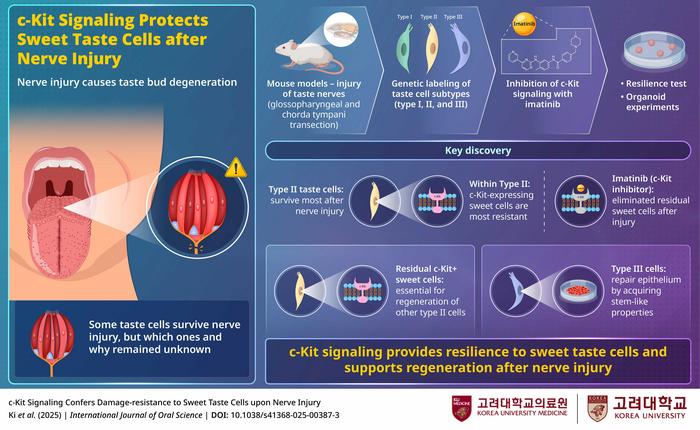 Sweet-sensing taste cells, supported by the protein c-Kit, show remarkable resilience when nerves are damaged, unlike other taste cells that quickly degenerate. Blocking c-Kit with the drug imatinib (Gleevec) eliminates these surviving sweet cells, highlighting the protein’s key role in preserving sweetness even after injury. Credit: Korea University College of Medicine[/caption]
Mapping taste recovery in mice and organoids
The researchers tested resilience by mimicking nerve injury in mice.
“We used nerve transection in mice to mimic injury and found that c-Kit-expressing sweet cells consistently survived. In organoid cultures, these cells continued to grow even when survival factors were withdrawn. But when we blocked c-Kit with imatinib, the surviving sweet cells disappeared, and regeneration was delayed.
“We also discovered that it’s not just sweet cells that matter. Some Type III cells acquired stem-like properties, helping repair the epithelial lining around taste buds. This shows that multiple cell types are involved in recovery – c-Kit+ sweet cells lead regeneration, while Type III cells contribute to repair,” Professor Jeong said.
Implications for future taste research
The discovery of c-Kit’s role in sweet-sensing taste cells opens exciting possibilities for the future of taste research. While immediate treatments are not yet possible, the findings offer a bank of crucial information that can be used to explore how taste buds recover and how specific taste cells might one day be targeted for therapeutic or nutritional benefits.
The discovery of c-Kit’s role in sweet-sensing taste cells opens exciting possibilities for the future of taste research.
“This is the first discovery that allows us to selectively control specific types of taste cells. While it does not immediately translate into treatment, it provides a foundation for future work on taste resilience and recovery,” Professor Jeong said. “In the long term, this could guide new approaches to improving nutrition, supporting patients with taste disorders, and even advancing flavour science. By identifying c-Kit as a key factor in sweet-cell survival, we now have a building block for more precise control over taste.”